A blog dedicated to chronicling the history of SC Green White, a soccer club founded in Chicago in 1956.

Monday, January 4, 2016

Available Now!

All of the stories on this blogsite and many many more are available in the book "Gruen Weiss Vor! 60 Years of Green White". The book includes 175 classic photographs too.

Order your copy today.

Wednesday, December 31, 2014

The Mid 90s

On October 19th, 1996, Green White held it's 40th anniversary banquet at Bristol Court in Mt. Prospect. Club president Horst Melcher had this to say on that momentous night: "The trophy cases in the clubhouse reflect the success of our teams over the years. Numerous league and state championships have been won by teams of all ages. However, the biggest success is the devotion of our many members who have volunteered countless hours over many years to work for the club, and build a strong soccer tradition."

Horst was working double duty in those days, as the president of both the senior and youth boards, assisted by VP Gus Bender on the youth side, and the many long time members who did all the work Horst referenced in his opening statements, names that have been part of Green White forever: Wittje, Schmidt, Metzinger, Kaempfer, Stadler, Zimmer, Kraemer, Harjung, Kilian, Gyurko, Mokran, Feichtl, Blaas, Kirschner and more.

Several were singled out for special recognition by the Master of Ceremonies (Rick Kaempfer from WJMK Radio) on that October night--Alex Gyurko for extraordinary services in coordination of referees at tournaments, Gus Bender for dedicated support of youth soccer at the club, community and state level, Anni Metzinger and Maria Zimmer for devoted service on the social committee, and Mr. Everett Weaver for the advance of soccer. Also, four long-time members were recognized for extraordinary dedication to the successs of the Green White Soccer Club: Hans Metzinger, Stefan Zimmer, Fritz Becker, and Horst Melcher.


On the field Melcher's son Kurt was now the goaltender of the first team. Among the other players on that team--holdovers like Stuart Davidson, Dan Vlaovic and Frank Speth, and the younger generation of players like Tom Czop, Bernie Czekajlo, Chris Salatino, Peter Kaempfer, and Jake Truty.


That team was a two-time defending champion of the national Donauschwaben tournament (1995 in Mansfield and 1996 in Chicago), but they were certainly not the only Green White team. As the club celebrated its 40th anniversary, Green White was the biggest team in the state. There were over 20 teams--teams for every age group of boys and girls--plus three men's teams and a ladies team. The boys team coached by Steve Pastorelli was the state champion. 19 players with the first team or reserves had come up through the youth organization. 40+ players from the youth organization had received scholarships to play soccer in college.

Green White even commissioned a song. "Green White is 40 Years Old Now" was written by Rick Kaempfer, and performed at the 40th anniversary banquet by the Johnny Wagner Band--and sung by two former Miss Green Whites. The full text of that song will be featured in the upcoming Green White history book.


Tuesday, September 30, 2014

1992--1994

During the early-to-mid 90s Green White fielded very strong teams.

It all culminated in 1994; a very important year not only for Green White, but for soccer in America. It was the year the World Cup was played here. Several members of the US Men's National Team came out to the Green White fields at Majewski (including starter Paul Caligiuri), and met some of our youth teams (photo). That's a moment that those boys will never forget.


That was not the only exciting event at Metro Majewski Park. A group of well known and soon-to-be well known players gathered for a match on the main field by the Green White clubhouse that same summer. It was probably the most famous group of players ever assembled to play on that field. Gus Bender helped arrange the match that was quietly billed as a "Friendly Amherst College Almuni Reunion game". But it was much more than that. The match actually pitted Amherst Alumni from 1979-1981 against a group of French Nationals. The most famous person on the pitch was Prince Albert of Monaco. He graduated from Amherst in 1980, and is now the ruler of Monaco (ever his father Prince Rainer died in 2005. His mother was Grace Kelly) Also playing (and scoring) that day was Jerome De Bontin. He graduated from Amherst in 1981, and later became the President of Monaco.

The friendly also saw former Yugolasivan and Croatian National Team player and coach Zlatko Kranjcar and his then 10-year-old son Niko tale the field. The father's playing career spanned 18 years, and his son followed in his footsteps, playing for EPL team Portsmouth (among others) and the Croatian National Team. Manning the goal that day was Georges Carnus who was a member of the French team that competed in the 1966 FIFA World Cup in England, and Jean Luc Ettori, another French keeper who played professionally with AS Monaco and was capped by his National Team nine times.

It was a very heady time, and Green White's performance on the field was in perfect sync with the moment. The First Team stormed through the indoor season in the very tough Major Division of the Metro League. Coach Marcus Laxgang remembers that team fondly. "That was a special year because we had such a good mix of new young players mixing in with older long time players."

Bernie Czekajlo was one of the younger players on that team, and remembers both the pressure, and the motivation provided by Green White's enthusiastic supporters at the Odeum.

"We had to answer to them after each game and practice," he says now, explaining how they helped. "Who wanted to face Mr Zimmer in the locker room after a loss? Or Mr. Metzinger. Or worse, Mrs. Zimmer, Moni and Tina. (Laughs) The fan section at the Odeum that I recall always being there included Mrs. Kaempfer and Cindy, Mr and Mrs. Horst Melcher, Mr. Mrs Walter Melcher, the Kowalskis, the Bischoffs, The Czops, The Metzingers, the Meschbachs, and our girlfriends and fiancees."

"We didn't start out well," Laxgang admits, but the team eventually gelled by playing together as much as possible. "We tried to make the practices competitive by training for an hour and then scrimmaging--usually against the Croatians who also won the lower league championship."

The race for the Metro League Indoor Title came down to the wire. Pegasus, Eagles, United Serbs and Green White battled it out all season long, but in the end it came down to a two team race between Pegasus and Green White. In the penultimate game of the season, the two sides met on the Odeum floor. The contest was tense and riveting. Goalkeeper (and 1994 team MVP) Kurt Melcher vividly remembers the moment.

"The indoor game versus Pegasus - second to last game - was epic. We needed a win or tie to keep the top spot. We were losing by one goal and we pulled the keeper (me) for the last minute to try to get a goal. I remember this like yesterday - With time winding down - Robbie Meschbach had the ball on top of the indoor box and dribbled forward. We had all players forward in good attacking positions - 99% of the time he would have taken the shot, but this time he played a perfect diagonal pass to Danny V just to the left side of the goal. With 1 second left Danny one touched it in the goal and we tied. We beat Lightening the next week and won the league!"

Presenting the victorious 1994 champs...Front Row (left to right): Mark Laxgang, Robert Meschbach, Stuart Davidson, Danny Vlaovic, Kurt Melcher, Wally Melcher, Brian Bischoff, Mike Duffy. Back Row (left to right): Rod Hogan, Tom Czop, Chris Ryan, Peter Kaempfer, Mike Byrne, Karsten Roy (son of longtime Chicago Sting coach Willi Roy), John Wolfe, Bernie Czekaljo. Not Pictured: Ron Knestrict. Team Coach: Mark Laxgang.


Green White Off The Field

Several players and teams were honored at the Sepp Herberger Sport, Radio, and Press ball every year during this era. The 1992 Old Timers team was named the team of the year. Green White team MVPs Peter Kaempfer (1993) and Kurt Melcher (1994) represented the First Team. And Green White ladies Tracey Pope ('94), Elizabeth Obrecht ('93), and Lisa Knaub ('92) served as Miss Green White. Green White member Rick Kaempfer served as the Master of Ceremonies.


The World Cup

The opening ceremonies of the 1994 World Cup are held in Chicago. It doesn't exactly start smoothly. Oprah Winfrey falls through a hole in the stage, and twists her ankle. A few moments later Motown superstar Diana Ross does the ceremonial first kick of the ball, and misses the net.

It goes better from there. The US Team advances to the second round for the first time in many decades.

The final game is played in Los Angeles. The game between Italy and Brazil goes to penalty kicks...


In Pop Culture

The number one song in 1992 is Boyz II Men's - End Of The Road

The number one song in 1993 is Whitney Houston's - I Will Always Love You

The number one song in 1994 is Ace Of Base's - The Sign


Elsewhere in the News

~William Jefferson Clinton is elected President of the United States in 1992, and begins serving his office in 1993.

~John Wayne Bobbit becomes a nationally known figure for one of the worst reasons imaginable.

~The 1994 Olympics in Lillehammer features the off-the-ice drama of Tonya Harding's ex-husband hiring someone to club her rival Nancy Kerrigan on the knee. Both skate, and neither win the Gold.


Coming next time: The mid-to-late 90s.

As always, if you have any thing to add or correct in this month’s installment, please drop me a line at amishrick@yahoo.com. I consider this a group project, and a work in progress, so we can add and subtract until we get it all exactly correct. If you have photos you’d like to contribute, please do.

Thursday, August 21, 2014

The Early 1990s


The late 80s/early 90s were a heady time for Green White, and one of the reasons for that was one of the best teams Green White has ever assembled.

The team was led by Illinois Soccer Hall of Famer Alex Gyurko. It began very early on, when some of the boys were quite young. Chris Salatino was one of those boys.

"I met the Gyurko family when I was only eight years old," he recalls, "and I'm very thankful for that. They introduced me to Green White when I was nine, and Maggie Gyurko (Alex's wife) picked me up and drove to every practice and game until I got my driver's license."

Throughout the 80s, the youth team kept adding pieces. Along with Alex's sons Peter & Mark, and Chris (Sal), when they reached the U-14 level, additional players came aboard. Erik Bender was one of those players.

"I joined G&W after having won the State Championship with Arlington Aces - Brian McBride was my goalkeeper," he remembers. "Mr Gyurko was a good recruiter and got along famously with my father who immediately got involved with the club."

Gus Bender (Erik's father) was a good recruiter too. With both Gyurko and Bender (another Hall of Famer) on the case, more and more pieces were added to the puzzle.

"Around the end of our U-14 season," Peter Gyurko recalls, "we knew we were getting there. We picked up a few key players like Erik and Blake Rodgers."

But their real success came during their U-16 season. Green White stormed through the regular season and made it to the State Cup. By now, Tom Czop was part of the team too.

"Our first year as a team at the U-16 level was the beginning of knowing how special our team could be," he says. "We lost in very controversial fashion in the U-16 State Cup Semi-finals to Sockers FC."

Salatino agrees. "Sockers had just started to become the 'power' club that it is today. They put together a team that was a year older than us and loaded it with great players at every position. They really had to scramble and dig deep, but ultimately beat us at the end. It was at that point that we thought, here is the best team in the state (they went on to win the tournament that year) and we were just as good. After that, we had a confidence that allowed us to compete with anyone, anywhere."

"That loss really focused our team," Czop concurs.

The trips they took together also brought the team together. Some even went overseas.

"Our team traveled to Germany our first year of U-16 with GW's U-19," Tom Czop remembers. "Peter & Mark Gyurko, Erik Bender, Peter Ternes, Blake Rogers, and Mike Byrne. I may be missing a few though."

"I remember all the guys got earrings on that trip except me," Bender says. "Today, I am glad I didn't."

"There are all kinds of stories from every tournament we went to," Salatino adds, ticking off some of their locations. "Kalamazoo, Dallas, Sioux Falls, Omaha, USA cup in Minnesota, St. Louis."

When the statute of limitations expires, some of those stories may even be told.


"Our team chemistry and friendships were what made all of our trips memorable," Tom Czop says, getting serious for a moment. "We probably did not have the most top or best players from our area, but we had such a tight-knit group and chemistry that made us such a successful team. Not only did we play and practice as a team, but we were friends off of the field as well."

But this tight knit group continued to add pieces. And a lot was asked of the new players.

Goalkeeper Shaun Fogarty explains what the new players faced. "There was a dedication there...training in the cold, playing through the pain and injuries, not skipping practices, being there for one another. From my perspective we also played as a team where new members had to adapt to the team more than the team having to adapt to new players."

Nate Osicka joined the team when he was in high school, and remembers being impressed. "I played at Stevenson High School up north with Blake Rodgers and he convinced Mr. Gyurko to take a look at me. By the time I joined the team it was already clear that this was a special group of guys. I remember Mike Byrne teaching me to step over the ball when I first arrived at practice. I really was pretty far behind a lot of the other guys at first and I really appreciated the couple of minutes he took to show me how to do a couple of things."

When the team played at U-17, they could no longer be stopped. Tom Czop recalls the first championship. "The 1989 U-17 State Cup title win over Sockers FC was special as we won our first state title and avenged the previous year's U-16 loss to them."

But it was just the beginning of their hardware.

"The following year's (1990) U-19 State Cup semi-final win over Sportsclub (now the Magic) was also very memorable," Czop adds. "Sportsclub had come out of nowhere with a south suburban all-star team and jumped out to a 2-0 lead on us in the opening 15 minutes. We managed to score two goals toward the end of the first half to tie the game up and then scored two second half goals for a dramatic 4-2 win and lead us to the eventual state title and berth to our first Midwest Regionals in Kalamazoo, Michigan."

Salatino has fond memories of one of their regional appearances, but for a different reason.

"For me personally, I'll never forget the regional tournament in South Dakota," he says. "I had hurt my knee in the spring and wasn’t able to play, but Mr. Gyurko still took me everywhere. At regionals, we were beating a team by three or four goals, so he put me in so that I could have the opportunity to just be on the field. As luck would have it, I hurt my knee again in the couple of minutes I was in there. I remember being on the ground and everyone on the team came over right away. Cesar Alfaro dropped down and just grabbed my hand to console me. Mr. Gyurko came over and literally carried me off the field. The game was over shortly thereafter and everyone hung around me to make sure I was okay. That’s not necessarily a memory of a big game, but a fond memory of how everyone really cared for each other amongst our group."

In 1991 this group reached their highest heights.

"Many of us had finished our first year of college," Fogarty recalls. "Some of us played ball in our first year of college and some of us did not. We picked up where we left off before leaving for college and just played so well. It was fun. We won the state cup. Then we won the regional cup. And then we went on the National Cup in Omaha."

"At the 1991 nationals semi-finals we got to play against Jason Kreis of RSL and now NYC fame who was on the Baton Rouge United Jags, a U-19 Select team," Nate Osicka says. "That was a big deal. I remember they edged us in the semi finals."

"Thanks to some horrible officiating," Erik Bender adds.


Despite the controversy, finishing in the top four of the country, was a tremendous accomplishment--the icing on the cake. In four years this group of Green White players had accomplished something no other Green White team has accomplished before or since. Before they were through playing together, they had won three consecutive state championships.

Their names will forever be connected in Green White history: Shaun Fogarty and Pat Cullnan (the keepers), Erik Bender, Mark Gyurko, Peter Gyurko, Peter Ternes, Rick Anderson, Blake Rogers, Tom Czop, Mike Byrne, Ricardo Tovar, Phil Imm, Cesar Alfaro, Tristan Nepote, Nate Osica, Gary Garcia, Chris Salatino.

The group remains so close to this day, they still knew how to contact each other for this piece.

"Many of us still talk and are good friends to this day," Peter Gyurko says. "We played soccer together but those were also our vacations. We played spring, summer, indoor multiple sessions, practiced all the time. We became a family, even the parents reminisce about those times."

Gus Bender, one of those parents, is still impressed with this group of guys. "This is an extraordinary group of men who realized early on that the game was part of a life-learning experience."

His wife Mary Jane agrees. "The camaraderie and experiences with the players and parents was amazing. A great club and team provide memories for a life time."

And the club is still near and dear to their hearts.

"For me," Erik Bender says, "the club taught me how to work hard. Guys like Mr Zimmer, Mr Kaempfer, Mr Melcher, Mr Gyurko, my father and a bunch of old Germans who used to pat us on the head and say, 'good game,' who worked tirelessly so that teams like ours could have these great experiences. Most of us who hung around the club and worked the tournaments have grown up to be pretty successful. That work ethic may be the best thing the club did for us."

"Alex, Gus and the entire Green White family had a tremendous influence on me during my teenage years," Fogarty says. "The club and the team were my family. I had the opportunity to experience many things that my friends outside of Green White didn't get to do. My fondest memories of youth soccer all involve Green White."

"It truly was our second family," Peter Gyurko adds. "We went to picnics together, holiday parties, dances, dinners, had sleepovers."

"Green White is my connection to a wonderful time in my life," Salatino agrees. "We had a great group of guys that got along well, took great care of each other and accomplished a lot of things together."

Tom Czop is still involved with Green White. "I learned to play for more than the love of the game but for the pride of our club and to support my teammates. It was always great to learn from the older players and teams above you. I believe the Green White club atmosphere was a key to our success."

And there's no doubt about who was most responsible for that.

"Those Green White values were instilled in us from our coach, Alex 'Sandor' Gyurko," Czop says.

"Alex was the catalyst," Gus Bender agrees. "He recognized that it was about kids having fun, but not without responsibility."

A few years ago the team reunited in honor of their beloved coach, and surprised him. Alex Gyurko, who has been with Green White since the 50s as a player, coach, and club member, says that day was the single greatest moment of his time with club.

"Most of the players from many different cities showed up," he says. "Fifteen out of the eighteen, and many parents too. It was so great to see them all one last time."

"One last time?" Salatino retorts. "I expect we’ll have another one. I’m pretty sure everyone is still active in soccer one way or another these days. I don’t think it’ll be too hard to pull it together for another run."

Monday, July 7, 2014

1989

Green White had a few big highlights, among them a trip to Germany (see below), but it was also a time of tragedy for the club. Within a few months of each other, original members Eckhard Kaempfer, Toni Kirschner, and Franz Fernbach all passed away. Each of them contributed greatly to the success of the club during it's first 33 years, and each of them are still missed today. They were only in their 50s.


On the field, Green White played a full season without Rudi Mayer for the first time in two decades. Richard Meschbach was named the first team's MVP and represented the club at the 25th annual Sport, Radio & Press ball along with Miss Green White, Terry Toth, and the master of ceremonies for that silver anniversary event, Green White's Rick Kaempfer.

But the real excitement came for Green White's U-14 boys team, led by Wolfgang Richter and Steve Pastorelli. That team went to Germany over spring break to play in Hanover, Kaiserslautern, and Niederrheim (among others). Once again, the Germans didn't know what hit them, as Green White won three games on the trip.

The roster for that team was: Ryan Ewanio, Jason French, Todd Svihla, Michael Hane, Scott Holper, Miro Ivelic, Michael McAdams, Carlin Metzger, Alan Piro, Christopher Trenn, Eric Urban, Ryan Peterson, Kurt Peterson, Kyle Peterson, Kevin Yoyen, and Anthony Pastorelli.

Here are a few pictures from that trip, courtesy of Steve Pastorelli...


In Pop Culture

*The number one song of the year was "Look Away" by Chicago.

*The Academy Award for best picture was given to "Driving Miss Daisy"

*The top rated television show of 1989 was "The Cosby Show"


Elsewhere in 1989

~George H.W. Bush takes the oath of office as the 41st President of the United States.

~Ted Bundy is executed in Florida.

~China cracks down on the student protests at Tiananman Square.

~Pete Rose agrees to a lifetime ban from baseball after evidence of his gambling on the sport emerges.

~An earthquake hits San Francisco during the World Series between two bay area teams, Oakland and San Francisco.

~The Berlin Wall comes down during protests. East Germans can leave their country for the first time in nearly 40 years.


Coming next month: 1990.

As always, if you have any thing to add or correct in this month’s installment, please drop me a line at amishrick@yahoo.com. I consider this a group project, and a work in progress, so we can add and subtract until we get it all exactly correct. If you have photos you’d like to contribute, please do.

Wednesday, June 11, 2014

1988

In 1988 Rudi Mayer’s long playing career with Green White ended after 28 great years. To commemorate the year 1988 in Green White history, we thought it would be fun to reconnect with Rudi and discuss his incredible soccer career.

GW: When did you start at Green White, and how did you hear about it?

Rudi Mayer: I heard about them because my dad went to the First Team games, and I played with the kids at the games who were all players with the Green White Juveniles. And they always asked “Why aren’t you playing with us?” I said “Because my mom won’t let me.” (laughs) She was afraid I was going to get hurt. My dad and uncle put some pressure on her, and she finally agreed, so I started playing indoors in 1960. We were practicing in a gym on Barry in Chicago.

GW: What are some fond memories from your Green White youth days?

Rudi Mayer: Some years we would win lots of games, sometimes 15-0, 10-0. And then some years we would lose games like that. It all depended on how many good players we had. At that time Juveniles were ages 7 to 15. We had 7 year olds playing against 14 year olds sometimes. I was 12 when I started.

GW: Who were the players that you looked up to when you were young?

Rudi Mayer: I didn’t really learn what soccer was all about until I was a little older, but when I really began to understand the game, I looked up to guys like Steve Zimmer and Steve Laxgang. Those guys were very good players. Toni Zimmer. Gottfried Winter. I watched them all every Sunday with my dad. That was our Sunday thing to do.

GW: Do you remember the first time you got to play with the first team?

Rudi Mayer: Oh yes I do. I remember it vividly. I had just turned 17. This was the spring before the team went to Europe and they decided they wanted some more players for the First Team and they decided I was ready, so they asked my father if I could play. He resisted it for a long time. I was a lot smaller than a lot of the guys on the first team, and he didn’t think I was ready. The games were pretty rough back then. In the end, Peter Erhardt, who was the coach at the time, talked my dad into it. Adi and Georgy Kaempf were on the team at the time. Klaus. Joe Laxgang. Steve Zimmer. I had a junior game in the morning, and they had me dress for the First Team in the afternoon at Hansen Stadium. In the second half they put me in. They put me on right wing, and I got a through ball on the right side, and the center back came across and knocked the s**t out of me. He didn’t try to tackle me, he just ran me over. He knew I was going to get past him and that he wasn’t going to be able to catch me, so he hit me so hard, I think I was knocked out for a second. I had to come out of the game. I think I played three or four minutes, and touched the ball twice. That was my first game. That was against the Liths. They had a big center back. Really big. I was young and thin and fast and he knew he wasn’t going to catch me. So he floored me.

GW: So did you go on that trip to Germany shortly thereafter?

Rudi Mayer: Yeah, I got to go on that trip. And that was great. It was a lot of fun playing against these Germans who thought the Americans couldn’t play. On that trip we played five games against first division amateur teams, and we won four and tied one. I got to start all five of those games at either center forward or right wing, and in those five games I scored eight goals. That was a riot. In hindsight, though, I think I played really badly. I was more lucky than anything. The Germans were better ball handlers and I was in the right spot at the right time. Of those eight goals, probably three of them were breakaways. They underestimated our whole team. They played possession, so they played in our half. Adi told me to just wait at the half line, and when he got the ball he just pointed at me and sent the ball, and I had at least three breakaways that way. (Photo: The Green White Germany Trip Group)

GW: Did you have any mentors in the Green White organization?

Rudi Mayer: Oh everybody, they all mentored me, but I think Adi Kaempf is probably the guy who helped me the most. He really mentored me and took me under his wing.

GW: You played in the 60s, 70s, and 80s with the first team. Do any highlights from each of those decades come to mind?

Rudi Mayer: We won a few championships indoors and one outdoors too. I remember that year we won it at Welles Park. We were demoted to the First Division and took it personally, and killed everyone, and then we made it back up to the Major Division and kept on winning. I got to play with my brother, which was great. He also started on the First Team when he was 17. That Green White Junior team he was on was really really good. That whole team kind of came up and replaced the existing First Team. I went from being the youngest player on the team to being the oldest just five years later. It was a lot of fun. (Photo: The Mayer Brothers)

GW: You were also named Player of the Year a few times during your Green White career. Was it two or three times?

Rudi Mayer: I was the Player of the Year three times. I got to meet the National Team coach of Germany—he handed me the Player of the Year Award. Actually, I got to meet two of them. Sepp Herberger handed me the award the first time I won it, and Helmut Schoen handed it to me the second time. That was a huge thrill. Uwe Seeler was one of my idols and he was there the last time I won it.

GW: You also played at Michigan State.

Rudi Mayer: I played there from 1968-1972. That team had great players. Olympic players from the U.S, Jamaica, and Canada. My first year there we won the National Championship.

GW: Did you ever play for the Olympic Team?

Rudi Mayer: I did make the Olympic team in 1972. However, even though I was named to the team, I broke my ankle skiing in January, and they started playing games in the spring. They left me on the roster hoping that I would get fit enough by the time we played in the actual Olympic games in June, but I barely had gotten my cast off by then. It was a serious break in my ankle. So I did get to practice with them, but not in the games.

GW: You also played for the Chicago Sting.

Rudi Mayer: Yes, I did. 1976 and 1977, I believe. I went to the tryouts and Bill Foulkes, a former Manchester United defender, was the coach. He asked me to be a part of the team, and I said yes. We played indoors and outdoors at the time. The outdoor games were at Soldier Field. It was always empty, except when we played against the Cosmos with Pele. Then we had 40,000 in the house.

GW: At that time most of the players on the Sting were English, weren’t they?

Rudi Mayer: Yes. I was one of the few non-English players on the team. The coach was using the team as a farm club for Manchester United. So my passing was a little too short. I didn’t play that English style of kicking the long ball and running people over. I was more a finesse player, and the coach didn’t really like that. I remember I started the first game of the season. We were playing the Tampa Ray Rowdies, and he didn’t tell us who was starting until two minutes before we walked out on the field, and he said: “OK, Rudi, you’re playing center back” I had never played that position before in my life. I wasn’t prepared at all. And who do we play against? We played against Rodney Marsh, an English National Team player, and Clyde Best who was a Jamaican National Team player. Those were their two center forwards. I had to cover Rodney Marsh. I thought, “Wow, he’s a great player and great ball handler”, but I did really well against him. Except for one time I took the ball away from him and passed it to my fellow back Alex, and Alex rather than stepping up and taking the ball, stepped even further back, which meant that Rodney Marsh got between us. He got the ball, out-dribbled Alex, and scored. I got blamed for the goal and was taken out of the game. And that was it. The coach never liked me after that. I played various different positions but couldn’t really work my way into a regular starting position.

GW: Did you ever try out for the U.S. National Team.

Rudi Mayer: Yes I did. I can’t recall exactly what year it was. Early 70s sometime. The tryouts were in St. Louis and they took mostly St. Louis players, but I believe they did take a player from the Lions and Schwaben, but nearly the whole team came from St. Louis.

GW: I’ve interviewed a lot of the old timers at Green White, and they swear that the quality of soccer back in those days was vastly superior than the quality we see today. What do you think of that assessment?

Rudi Mayer: I think the quality of the soccer then was better than it is now in the Metro League, although the current crop of Metro League guys are more fit and run more—most of them are right out of college and they’re used to that. Our team wasn’t as fast, and we weren’t as fit. But our creativity, the quality of passing, the playmaking, the imagination, and finesse was very good in those days. Our quality at that time was more on the level of the MLS today—again, without the fitness and the speed. Don’t forget that we had pros coming from Europe routinely playing in our league at the time. Guys who were in their late 20s/early 30s, that might have been just past their prime or didn’t get the big contracts in Europe. The Croatians had five National Team players at one time. The Maroons had good players. Adolf Bachmeier from the Kickers—he was my idol for a long time. I thought he was the best German player ever to play in Chicago.

GW: So what made you decide it was time to hang it up with Green White after nearly three decades?

Rudi Mayer: 1988 was the year my daughter was born. I figured I had to be home to hold her. No more practicing. By that time I was 38, and without practicing three times a week, I couldn’t keep up with the 24 year olds anymore. It was time.

GW: What has Green White meant to you?

Rudi Mayer: That was my second family. I knew everybody. Everybody knew me. It was just great being there. We were all friends, really. Even though there were age differences, when we got together it didn’t matter if you were 21 and the guy you were playing with was 33, it didn’t matter. You were buddies. You liked each other. You played for each other. We fought for each other. The spectators were always there for us—the members who came out to support the team—they really made us want to play well. We wanted to win for them, to make them proud, to give them the kind of team they wanted. There were 400 of them—and they were our extended family. It was a great feeling and I really miss it.


More from 1988

*An Illinois Soccer Hall of Famer Robert Meschbach was Green White's MVP and player of the year in 1988.

*Club Co-founder Adam Harjung's daughter Laura served as Miss Green White.


Elsewhere in Soccer

USSR faced the Netherlands in the European Cup final (in Germany). The Netherlands were victorious, 2-0.


In Pop Culture

*The number one song of the year was "Faith" by George Michael.

*The Academy Award for best picture was given to "Rain Man"

*The top rated television show of 1988 was "The Cosby Show"


Elsewhere in 1988

~The 1988 Winter Olympics were held in Calgary Alberta.

~Lieutenant Colonel Oliver North and Vice Admiral John Poindexter were indicted on charges of conspiracy to defraud the United States.

~Sonny Bono was elected Mayor of Palm Springs.

~The 1988 Summer Olympics were held in Seoul, South Korea.

~Vice President George Herbert Walker Bush defeated Massachusets Governor Michael Dukakis to become President of the United States.


Coming next month: 1989.

As always, if you have any thing to add or correct in this month’s installment, please drop me a line at amishrick@yahoo.com. I consider this a group project, and a work in progress, so we can add and subtract until we get it all exactly correct. If you have photos you’d like to contribute, please do.

Wednesday, April 30, 2014

1987

In the wake of their 30th anniversary the previous year, Green White made several hat tips to their past in 1987.

Every year the players on Green White chose a most valuable player of the First Team. In 1987, the team of mostly younger players gave the award to the man who had been their goaltender for more than fifteen years; Hardy Ritter (photo). Ritter starred as the keeper of the 1970 and 1971 youth championship teams before joining the first team. It seemed only fitting to honor him for his twenty years of outstanding play for Green White. (Ritter also received invitations to try out for the U.S. Olympic team in his earlier years).

At the 30th anniversary party the club also saluted all of the previous winners of Miss Green White. One of the honorees was the first Miss Green White, Helga Peltzer, who was now known as Helga Albrecht. She won the crown in 1963. Well, 24 years later, she must have been proud when her daughter Andrea Albrecht wore the same crown. They became the first (but not the last) mother-daughter combination to serve in that role. Andrea was 17 years old and studying at Loyola University at the time of the Sport, Radio, and Press ball.

Nearly every Green White member was in attendance at the dinner that year, because club founder Martin Schneider was honored as Sepp Herberger's Man of the Year. His long-time friend (and fellow Green White member) Wilhelm Franz was the Master of Ceremonies. This is a short excerpt of what he had to say...

"Mention the name Martin Schneider in soccer circles in Chicago and you really need no further description. Martin Schneider is known for his long commitment to soccer. His willingness to be of help whenever and wherever needed has made him any friends, not only within his own club (SC Green White), but all German-American soccer clubs in the Chicago area. No sooner did Martin arrive in Chicago, when he joined others to found the SC Green-White. As all of us recall, the early 50s were the golden years of post-war soccer in Chicago. Those were the years when it took hard work to even secure playing fields. It took the patience of a person like Martin Schneider to guide his club through the early turbulent years, and there is no position within the club that Martin did not hold at one time or another.

From the very beginning Martin was a member of the Sepp Herberger Commitee as well, and again, true to his character, has held many positions. The purpose and results achieved by the committee need not be described here, for they are well known. One of our commitments has always been to be an active part of the German-American community. Most visible is our participation in the Steuben Parade.* All the work behind the scenes is usually in the hands of Martin Schneider. (Photo: Martin Schneider/middle at the Steuben Parade with Wilhelm Franz/right and Green White board member Eckhard Kaempfer/left)

Our thanks for a job well done, Martin Schneider!"

*For our younger members, the Steuben Parade was featured in this 1980s classic film "Ferris Buehler's Day Off"...Note the German outfits...


Green White Youth

1987 was a big year for the Green White youth program. Both the U-16 boys team (led by Alex Gyurko) and the U-19 boys team (led by Walter Melcher and trained by Frank Speth) went to Germany to play a series of exhibition games. For most of these boys it was their first time visiting.

Peter Kaempfer was a member of the U-19 team and remembered it this way: "Our U-19 team did very well against the mighty Germans. I think we were 3-0-3, undefeated. Staying in the homes of some of our opponents led to some interesting stories too, especially the ones that had no ability to communicate with one another at all. The team from Kaufbeuren was especially hospitable – we hit it off well with them – and returned the favor when they visited us in the US the next year."

Kaempfer neglects to mention that he also lost his passport, and had to be left behind as the U.S. Embassy made him a new one. Here are a few photos from that memorable trip...


In Pop Culture

*The number one song of the year was "Walk Like an Egyptian" by The Bangles.

*The Academy Award for best picture was given to "The Last Emperor"

*The top rated television show of 1987 was "The Cosby Show"


Elsewhere in 1987

~The Dow Jones closed above 2000 (and then later 2500) for the first time.

~Pennsylvania politican Bud Dwyer shot himself during a live televised press conference

~President Reagan addressed the nation and admitted dealing arms for hostages

~U2 released "The Joshua Tree"

~The largest indoor audience for a sporting event in history attended WWF's Wrestlemania III in Pontiac, Michigan; more than 90,000 fans. (That record has since been broken)

Coming next month: 1988.

As always, if you have any thing to add or correct in this month’s installment, please drop me a line at amishrick@yahoo.com. I consider this a group project, and a work in progress, so we can add and subtract until we get it all exactly correct. If you have photos you’d like to contribute, please do.

Sunday, March 30, 2014

1986

On October 26, 1986, Green White celebrated their 30th anniversary at the Schwaben Center in Buffalo Grove. It was a night to remember the club's glorious past, to honor those who were contributing to the club in 1986, and to celebrate a bright future. (Photo: Board Members Frank Stadler, Franz Fernbach, Horst Melcher, Fritz Becker, Stefan Zimmer, and Hans Metzinger)

The awards ceremony began with recognition of board members who had served for more than twenty five years, club founders Fritz Becker, Frank Stadler, Horst Melcher, Adam Harjung, Eckhard Kaempfer, and Henry Wittje.

Board members Gus Bender, Walter Melcher, and Steve Zimmer were also given awards in recognition of meritorious service, Hans Metzinger Sr. was honored for being the longest tenured president in Green White history, and Mr. Everett Weaver and the Mount Prospect Park District were given awards for promoting the sport of soccer.

Miss Green White 1986 Renee Kilian was recognized as well.

Then it was time to honor the players. Frank Speth and Hans Metzinger Jr. were recognized for their contributions to the team, and Frank Schmaltz was named Green White's Player of the Year. The entire first team was on hand to applaud his performance. Among his First Team teammates in 1986 were Mike Andres, Mike Blaas, Marcus Laxgang, Robert and Richard Meschbach, the Arciniegas, and Rudi Mayer. Yes, Rudi Mayer was still playing on the First Team.

The program book listed the all-time leading scorers in Green White history as of 1986. At the top of the list were brothers Rudi Mayer (184 goals) and Hans Mayer (143) (photo), followed by brothers Adam Kaempf (138) & Georg Kaempf (124), A. Kelm (110), John Woolfe (101), Rudi Hrbacek (94), G. Winter (83), Stefan Zimmer (63), and P. Berger (63).

The players who had logged the most games played were Joe Laxgang (856), Stefan Zimmer (625), Rudi Mayer (611), Nick Willer (558), and John Woolfe (530).


The youth program

Green White had thirteen teams in 1986, and many of them were achieving quite a bit of success on the field. The U-19 team, led by coach Robert Mokran, won their division, and provided a pipeline of young players to the First Team, including Danny Vladic and Walter Mecher Jr. The U-19 Strikers team coached by Horst Melcher, was no ordinary B team. They featured players who would contribute for years to come, including Bernie Czekajlo, and Goalie Kurt Melcher. The U-16 team featured the likes of John Woolfe Jr., Peter Kaempfer, Brian Bischoff, and Tony Melcher.

In 1986, there were two U-14 teams led by coaches Hawkins and Stadler. The Hawkins-led team had a player named Cole Lanham who has a son (Max) playing for Green White today (the U-11 Cosmos), and the U-14 Strikers team featured current Green White board member Robert Stadler.

Green White also had a Ladies team coached by Klaus Kilian. The team was captained by Arlene Mayer (a former Miss Green White), and featured 1986's Miss Green White (Renee Kilian) and the previous Miss Green White Monika Zimmer.


Elsewhere in Soccer

The 1986 World Cup was held in Mexico. The four semi-finalists were West Germany, France, Belgium and Argentina. Argentina beat Belgium to reach the finals and West Germany beat France. That led to a very memorable World Cup Final in the oppressive Mexican heat. Argentina jumped out to a 2-0 lead, but West Germany stormed back to tie it, with goals from Karl Heinz Rumminigge and Rudy Voeller. With seven minutes left to go in the game, Diego Maradona fed his teammate Jorge Burruchaga with a perfect pass, and Argentina won the game 3-2. Maradona won the Golden Boot award as the best player.


In Pop Culture

*The number one song of the year was "That's What Friends Are For" by Dionne Warwick, Gladys Knight, Stevie Wonder & Elton John.

*The Academy Award for best picture was given to "Platoon"

*The top rated television show of 1986 was "The Cosby Show"


Elsewhere in 1985

~The Chicago Bears won Super Bowl XX by crushing the New England Patriots 46-10.

~The Space Shuttle Challenger carrying teacher Krista McCaulife blew up in the sky killing everyone aboard.

~Microsoft held it's initial public offering of stock.

~The Chernobyl nuclear disaster occured in the Ukraine, killing thousands of people and costing billions of dollars.

~5 million people linked hands across the country for "Hands Across America" to raise money to fight hunger.

~The Iran-Contra Affair was revealed to the American public for the first time.


Coming next month: 1987.

As always, if you have any thing to add or correct in this month’s installment, please drop me a line at amishrick@yahoo.com. I consider this a group project, and a work in progress, so we can add and subtract until we get it all exactly correct. If you have photos you’d like to contribute, please do.

Thursday, February 27, 2014

1985

After their big championship season of 1984, a few of the First Team players moved on and played for different clubs, but the core of the club remained. One key member, John Dunkas, was injured during the season, thinning their roster further. When Green White staged a men's tournament at their new fields in the summer of 1985, they dipped back into their archives for some help. Among the players they brought back was one of their all-time greats, John Woolfe. He may have been getting up in age, but John still had the touch, scoring a key goal in a Green White victory.

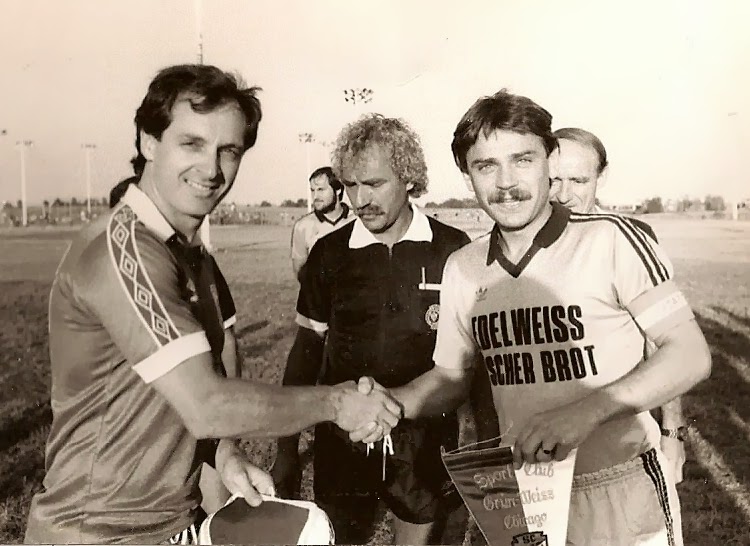
Just a few weeks after that, Green White got a visit from an Austrian team, Edelweiss Linz. They scrimmaged at the Green White fields, and the home team was victorious. Final score: Green White 1--Edelweiss Linz 0. (Photo: Green White captain Rudi Mayer greeting the Edelweiss captain before the game)

While Green White lost a few players, they also welcomed back Mark Laxgang. Mark's father Stefan, and his uncle Joe, were widely regarded as two of the best players to ever wear a Green White uniform. Mark's cousin Mike Blaas had been one of the players holding down the fort while Mark was away at college, and had played a key role on the 1984 Green White championship team.

A lot was expected from Mark. He had just graduated from Indiana University, which he attended on a soccer scholarship. The Tacoma Stars had just drafted him with their first round pick. But instead of playing pro ball, Laxgang returned to Chicago and donned the same Green and White colors he had been wearing since the age of seven. Mark didn't disappoint the Green White fans upon his return. He led the team in scoring, was named their MVP, and was recognized at the Sport, Radio, & Press ball as Chicago's Player of the Year. That made him the fifth Green White player to be so honored. (The others were John Woolfe 1968, Rudi Mayer 1972 & 1975, Hansi Mayer 1973, and Roberto Arceniega 1982).


Green White Off The Field

The final Zimmer girl, Moni, was named Miss Green White in 1985. (Photo: President Hans Metzinger, Miss Green White Moni Zimmer, and her proud dad Stefan Zimmer)

In those days, Miss Green White was expected to give a speech. This is a portion of Moni's prepared remarks from 1985...

"I have been a Green White member all my life, and for as long as I can remember, have been spending every Sunday at the soccer fields. I have been playing soccer since the age of eight and have currently finished my last season in high school. I am still playing with the Green White Ladies Team and will continue to do so. My parents have been active members of Green White since the club was founded. My dad is now the coach of the first team. Soccer plays a big part in my life, and I find it a great honor to have been chosen to represent the Green White Soccer Club."


In Pop Culture

*The number one song of the year was "Careless Whisper" by Wham.

*The Academy Award for best picture was given to "Out of Africa"

*The top rated television show of 1985 was "The Cosby Show"


Elsewhere in 1985

~Ronald Reagan was inaugurated for his second term as President of the United States.

~Live Aid, a gigantic charity concert for the starving people of Africa, was held in both Philadelphia and London simultaneously. Sting, U2, Queen, David Bowie, The Who, Elton John, Paul McCartney, Madonna, Tom Petty, The Cars, Led Zeppelin, Tina Turner, and the Rolling Stones were among the many acts. Phil Collins appeared in London, then flew to Philadelphia and appeared there too.

~Michael Jordan was named Rookie of the Year.

~Da Bears had one of the most incredible seasons in football history, going 15-1, and clinching a spot in the Super Bowl. (Spoiler Alert: They won it in early 1986)


Coming next month: 1986.

As always, if you have any thing to add or correct in this month’s installment, please drop me a line at amishrick@yahoo.com. I consider this a group project, and a work in progress, so we can add and subtract until we get it all exactly correct. If you have photos you’d like to contribute, please do.

Friday, January 31, 2014

1984


1984 might just have been the best year in Green White First Team history. This picture (above) was taken at the Schwaben Center, the day Green White clinched the Major Division Championship.

"That team was made up of a very special mix of players," 1984 Team MVP Frank Speth recalls. "Half the team was experienced and the other half, was still wet behind the ears. Experience & youth, what a combination!"

John Dunkas remembers it the same way. "Great crew as it had a mix of both older and younger players."

The team was managed by Steve Zimmer and Hans Metzinger, and Speth recalls the roles of each of the players. "Our leader was the never aging Rudi Mayer. In addition, we added a little Polish flair to the team that year w/Joe, Tony & Lester, all whom were very key contributors. Our other veterans were Roberto Arciniega, Nick Wosnyj & Hansi Metzinger Jr. The youth group, (who did the dirty work & all the running by the way) were led by goalkeeper Matt Clark, (who still looks the same today), defenders Mike Andres, Frank Schmaltz & myself. The workhorses in the midfield & up front were Mike Blaas, Rich Hart & John Dunkas."

Dunkas will never forget the day captured on film above. "The final game was against Schwaben and it went down to the wire. We won 2-1 with less the 5 minutes left." Dunkas scored the winning goal in his last healthy season with the first team. (He was injured the following year).

The First Team later also won the Amateur Cup and the Donauschwaben Tournament.

“A Season to Remember," Frank Speth says to this day. "We were so happy to make all the Green White members proud again."


Green White Tournaments

Throughout the 1980s, Green White tournaments were staged every year. Here are a few pictures of the people helping out at the Green White chuck wagon, some familiar faces and key Green White members. The top photo left to right, Helen Melcher, Hilde Becker, Rolf Albrecht, Annie Metzinger, and Trude Winterkorn. In the bottom photo, left to right Gus Bender, Eckhard Kaempfer, Herta Melcher, and Horst Melcher.


Green White Off The Field


Green White women's team player, and life-long member (to this date) Sonja Melcher (Nilson) was named Miss Green White 1984/85. She is celebrating her 30th annivesary as Miss Green White by wearing her sash and tiara to work every day this year. Right Sonja?


Elsewhere in Soccer

~The European Championship was held in France, and West Germany had a disappointing tournament, failing to reach the semi-finals after losing to Spain 1-0. The host nation France won it all. Michel Platini scored nine goals in the tournment to lead his country to the title.


~The Chicago Sting played their final outdoor season. One of the members of that last Sting team was former Green White player Robert Meschbach.


In Pop Culture

*The number one song of the year was "When Doves Cry" by Prince.

*The Academy Award for best picture was given to "Amadeus"

*The top rated television show of 1984 was "Dynasty"


Elsewhere in 1984

~George Orwell's novel did not come true.

~The first personal computer by Apple was unveiled in an iconic Super Bowl commercial.

~The Chicago Bulls drafted Michael Jordan with the third pick in the NBA draft.

~Ronald Reagan was re-elected president in a landslide victory over Walter Mondale, and the first female vice presidential candidate in American history, Geraldine Ferraro.

~The Chicago Bears made it to the NFC Championship game, losing to eventual champs, the San Franscisco 49ers.


Coming next month: 1985.

As always, if you have any thing to add or correct in this month’s installment, please drop me a line at amishrick@yahoo.com. I consider this a group project, and a work in progress, so we can add and subtract until we get it all exactly correct. If you have photos you’d like to contribute, please do.

Tuesday, December 31, 2013

1983

1983 was the first full season in Mt. Prospect for Green White, and while some of those games were a little rough because the field wasn't quite in shape yet, Green White managed to hold their own despite losing their star striker Robert Meschbach (he was playing professionally for the Ft. Lauderdale Strikers alongside former German superstar Gerd Mueller). Frank Schmaltz (photo) was one of the players on that year's first team, along with the Speth brothers and Hans Metzinger Jr.

As for the younger Green White clubs, once again a Green White youth team won the state championship. The U12 team led by Joe Schlenhardt did it again, the third year in a row a Green White U12 team won the championship.

With the new fields, Green White also was able to finally do something they had dreamed of doing for years--hold their very own tournament. It was a huge undertaking, but for the crew that had just spent the last year and a half literally building fields and a clubhouse from scratch, this was a task they were ready to tackle.

Helmut Filian was in his last year running the youth organization and he remembers it well. "We had the first youth tournament in the area here in 1983. We had 50 or 60 teams. That was no easy job because we didn’t have computers to create the brackets or anything. We were lucky that Alex Gyurko helped us get the referees—he convinced them to whistle for free that first tournament to help us build this thing. That whole tournament was a huge undertaking. Everyone pitched in—some helped out in the chuckwagon--some helped out on the fields, some helped to keep track of the brackets, some helped with traffic. Everybody helped, and I mean everybody. I got the teams to get here—that was my job.”

Former Green White President Hans Metzinger chuckles at the memory of the kids helping out. "We made some benches for the spectators, and had a few of our kids help paint them. Peter Kaempfer and Kurt Melcher had more paint on their faces than they had on the benches because didn’t turn the planks, they went underneath to paint them."
Green White Off The Field

The one down side to moving out to Mt. Prospect was the loss of the Donauschwaben banquet hall in Chicago. That made it a little more difficult to stage some of the annual social events the club had been having for the past 27 years. Needless to say, that little hiccup didn't stop the party. Most events were moved to the Schwaben Center in Buffalo Grove, including the annual Schlachtfest (an event that still goes on to this day). This picture was taken there.

Once again a Miss Green White was crowned. In 1983 it was future club president Cindy Kaempfer (photo), who went on to be named Miss Soccer at 1983's annual Sport, Radio & Press ball. Some of the first team players and coaches are in the picture with her including a very young John Dunkas, Frank Schmaltz and Frank Speth (back row), Mike Andres (glasses) and coach Stefan Zimmer.

In Pop Culture

*The number one song of the year was "Every Breath You Take" by The Police.

*The Academy Award for best picture was given to "Terms of Endearment"

*The top rated television show of 1983 was "Dallas"


Elsewhere in 1983

~The Chicago White Sox won their division and lost to the Baltimore Orioles in the ALCS.

~Chicago Archbishop Bernandin was named a Cardinal by the Vatican.

~Michael Jackson's "Thriller" album went to #1 and stayed there for 37 weeks.

~Vanessa Williams became the first black Miss America.

~Ronald Reagan signed a bill declaring Martin Luther King Day as a national holiday.


Coming next month: 1984.

As always, if you have any thing to add or correct in this month’s installment, please drop me a line at amishrick@yahoo.com. I consider this a group project, and a work in progress, so we can add and subtract until we get it all exactly correct. If you have photos you’d like to contribute, please do.

Saturday, November 30, 2013

1982


By 1982, Green White's home field was no longer Welles Park. Green White had been sharing the field with the Fichte Rams, and now the city was also allowing other teams to play there, so it was crucial that Green White find another place to play. They found some fields in Northbrook, but they knew it was only a temporary arrangement. The fields were being lent to the club for nothing, and it was only a matter of time before they were reclaimed.

Luckily for Green White, that season they had a player on their team named Paul Weaver. His father, Everett Weaver, was a big supporter of Green White, and put his time and money where his heart was. Mr. Weaver (as everyone called him) helped spearhead the search for a new field and a new clubhouse.

Helmut Filian was running the youth program for Green White at the time. "I spent days with Mr. Weaver driving around and scouting locations. We went all over the place; north, south, east and west. He kept finding potential spots for us, but none of them were quite right."

"We had a location on Northwest Highway," Hans Metzinger says. "And another one near Higgins, and another that is now used by United. We even looked at an old airfield. There was a lot of land there, but I said--'Where can we put the fields?'”

Finally they got a big break.

“I was on the board of the Young Sportsman Soccer League, and they told me that there was some land that was controlled by the Mount Prospect Park District," Helmut Filian (photo) recalls. "At the time there was nothing there at all—they were building the waste treatment plant—but that was it. Just nothing. So Mr. Weaver and I came over to look at it. There was this little house (our current clubhouse) that the Corp of Engineers was using as an office, and a place to store their stuff, but there was lots of room to create some fields. I went with (long time Green White Preisdent) Horst Melcher to lots of meetings with the park district, and they agreed to let us develop that land, and assured us that they would support us, but only if we financed it and did all the work to create those fields.”

That was no small project. This was a project that would cost hundreds of thousands of dollars, and would require hundreds and hundreds of man hours of work. Once again, Mr. Weaver came to the rescue.

"We didn't think we could raise that much money," Hans Metzinger recalls, "but Mr. Weaver gave us a check for $80,000. That was a good start. I remember Mr. Mokran gave us a lot of money too."

"Everybody from the club gave whatever they could give," Hildegard Kaempfer remembers. "A lot of us had kids going to college, so we didn't have a lot of money, but we still gave whatever we could."

"We did a big fundraiser at a nearby hotel," Helmut Filian adds, "the biggest one we've ever done. We had a big club at that time, and everyone contributed."

But securing the financing was only part of the process. There was still the challenge of converting the vast rocky ground into playable soccer fields. It turned out to be a bigger challenge than anyone realized.

“The biggest problem with the land was there were lots of stones," Klaus Kilian says. "We spent so much time and effort getting all of those stones out of there.”

Luckily a few of the Green White members had their own businesses, and they enlisted the help of their workers. "Helmut Filian sent his work crews over to help, and so did I," Hans Metzinger recalls. "We excavated the land with 50 men. We had lots of engineers. Horst Melcher, Eckhard Kaempfer, Toni Kirschner, Franz Stadler, they all helped out. Mr. Schmaltz made something to mark the fields with, and he went out there and marked it. Simon Andres, Konrad Meschbach, Helmut Filian, and Stefan Zimmer were the ones that really created those fields and got them ready to go."

“It was horrible at first," adds Helmut Filian. "We seeded it and re-seeded it. We spent a fortune trying to get it playable. The board declared that we were going to have a grand opening, so we really had to work hard to get it done on time. I took two weeks of vacation just to work on it, and so did a lot of the other guys.”

"These two fields closest to the clubhouse weren't even the hardest ones," Metzinger remembers. "We called the field on the hill the potato field because it was about as smooth as a potato and craters and holes all over it."

And if that wasn't enough, the club was still searching for a clubhouse. They almost bought a home nearby, but they kept looking at that little Corp of Engineers office.

"The Army Corp of Engineers was going to tear it down," Kilian says. "It was a mess. They had the whole garage stacked to the ceiling with garbage, and they had a makeshift office here. There was only one bathroom in the middle of the house.”

Again, Mr. Weaver came to the rescue.

"Mr. Weaver found them a better place to go, and convinced them to let us take over this house instead of tearing it down," Hans Metzinger remembers, "but again this was going to cost us a lot of money and effort to improve it. A lot of man hours. Every single worker, every single penny came from Green White.”


"We did it all," Klaus Kilian says. "We tore down walls. We made the kitchen. We dug out the basement. We built the deck. We did it with our own hands. Hans Metzinger was our project manager. He was the superintendent. He led the whole project. We had to do a lot of structural work, because the middle pillars that are in the clubhouse now is where the back wall was…and it was a load-bearing wall."

“Klaus did all the plumbing," Metzinger adds. "Rolf Albrecht did a lot of work. Tony Filian. We poured the concrete. We paid a few of the younger guys to help out. Eddie Speth was there. Stefan Zimmer was there. Polaretzky. Nick Willer and I did the whole deck. Franz Fernbach. You name it, everyone was out there.”

Even the players got in on the action. John Dunkas was on the first team at the time.

"After practice," Dunkas recalls, "they handed us shovels and said start digging."

There was one last touch before the fields could be christened. Once again, Mr. Weaver stepped up with one last grand gesture.

"He donated the lights," Helmut Filian says. "That was his gift to the club."

When the Grand Opening occured, something had changed forever.

"Hans Metzinger donated a construction trailer because I wanted a hot dog stand," Helmut Filian says. "We painted the trailer green and white, and when it was done we had our chuckwagon. When we finished painting it, we put our logo on there. It was the first time we had ever called ourselves ‘Green White Mt. Prospect’ and that’s what we’ve been ever since.”


(Photo: The Green White chuckwagon. Maria Zimmer at the window. Green White Ladies Team members Sonja Melcher, Moni Zimmer, and Miss Green White 1982 Arlen Mayer say hello)


Green White On the Field

Maybe it was because he had been spending so much time working on the fields, but when it was time for the national Donauschwaben Tournament in 1982 (in Cleveland Ohio), Hans Metzinger Sr. laced up his boots and played with the team. The 52 year old entered the game in the second half of an open match against Cleveland Concordia and scored two (2) goals in the 4-2 win, much to the consternation of Mr. Haller, Sr. of the Concordia Club.

The Green White first team had a good season, led by the player of the year, Roberto Arceniega, but once again it was one of the youth teams that was the pride of Green White in 1982.

The U-12 Boys team, led by coach Joe Schlenhardt, won the state championship for the second year in a row, despite losing many of it's star players from the year before to the older team. Peter Kaempfer was the captain of that team. "It was a great team," Pete recalls, "Although it hurts to realize my greatest sporting achievements were behind me by the age of 12 (laughs)"


Elsewhere in Soccer

The 1982 World Cup was held in Spain. The two finalists were Italy and West Germany. The West Germans made it to the final by beating France in one of the most dramatic games in World Cup history. The game went to overtime and in the first few minutes of overtime, the French scored two goals to take a 3-1 lead. The Germans only had 12 minutes to come back, and come back they did. Karl Heinz Rumminigge scored to make it 3-2, and then in the 108th minute Klaus Fisher tied the game with a dramatic bicycle kick. They then won the game on penalty kicks.

But in the finals, luck ran out for the German side. Led by Golden Boot winner Paolo Rossi, the Italians prevailed 3-1.


In Pop Culture

*The number one song of the year was "Let's Get Physical" by Olivia Newton John.

*The Academy Award for best picture was given to "Ghandi"

*The top rated television show of 1982 was "60 Minutes"


Elsewhere in 1982

~John Hinkley was found not guilty of attempted assassination by reason of insanity.

~Princess Diana and Prince Charles welcomed the birth of their first born son, William.

~The first issue of "USA Today" hit the newsstands.

~Cyanide-laced Tylenol killed seven people in Chicago. The murderer was never captured.

~The first artificial heart is transplanted into dentist Barney Clark. He survived for 112 days.

~The first episode of "Cheers" airs on NBC.


Coming next month: 1983.

As always, if you have any thing to add or correct in this month’s installment, please drop me a line at amishrick@yahoo.com. I consider this a group project, and a work in progress, so we can add and subtract until we get it all exactly correct. If you have photos you’d like to contribute, please do.